Theatre Reviews
1 KING, 2 PRINCES, & SHAKESPEARE'S LIE - Slade Wolfe Enterprises Limited
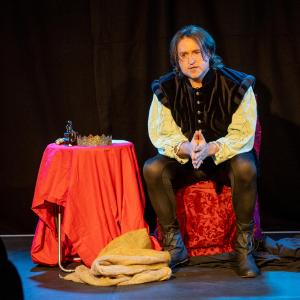
A one man stage performance was the order of the day this afternoon at Underground at Spring Gardens when King Richard III was present to challenge our knowledge and pre-conceptions about this infamous character, and his actions, as defined in our history books.
The audience assembled were the jury, and this monarch was to plead his case. The charge to be judged was quite plainly; is this man before them a villain? Is he a murderer? Did he possess a heart so dark that he could have 2 little boys murdered to protect his position of authority? King Richard III was to put his case to us and we were to decide.
Using very successful and powerful sound and lighting techniques to produce an eerie background against which to present this monologue, the audience were guided to question what they knew about this last Plantagenet monarch and the authenticity of that knowledge. Had perhaps the greatest playwright in the world maligned this King in an effort to produce a crowd pleasing story which would more than satisfy his Queen and gain favour with her.
Andrew Slade gave a stunning and flawless performance which engaged the audience from start to finish. With a superb projection of voice and clarity of diction which allowed every word to be heard coupled with a minimum of stage setting, he transported us back many hundreds of years to allow us to reflect upon this tale of treachery which often defines our history as a country.
This performance is highly recommended and is not to be missed. With performances on Tuesday 14th, Wednesday 15th , Thursday 16th and finally Friday 17th July - do take your opportunity to time travel and hear this King plead his case in person and then - well, make up your own mind.
Julie Alexander
THE CAGEBIRDS - Chapel Players
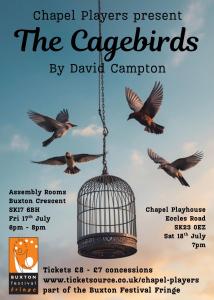
David Campton’s allegorical play is set in one room, containing six women. In Chapel Players’ production of the play, staged in the sumptuous setting of the Assembly Room of Buxton Crescent, this is a gilded cage. The audience enters to find the six women – clad in vivid colours, circling the room, as if in a fugue state, each uttering non sequiturs based on their individual obsessions – food, bodily ailments, beauty and ageing, gossip, the state of society, fear. It becomes clear that these caged women are being kept there by a domineering, but kindly Mistress, who then introduces a new inmate to their number.
Director Helen Bates uses the space excellently to put the audience in the centre of the action, with the women moving around them throughout the performance. The play offers vivid, larger-than-life characters to a strong cast of actresses who embrace their roles with vigour. I particularly enjoyed Angela Buttrill’s angry, strident Thump and Jill Gubbins’ Gossip, who begins conversationally but displays a fascinating vocal change towards the play’s end. Most memorable, however, was Josie Kelly as The Wild One, the woman put in amongst these institutionalized ‘birds’ who immediately challenges their habitual acceptance of their situation. Full of energy and clarity (the room, though beautiful, has some acoustic challenges), with her arguments powerfully conveyed, this is an outstanding performance.
Mention must be made of the hair and costume design from Jonathan Cheetham, and the make-up of Heloise Green and Lila Green, which work together to create distinctive looks for each of the women and a heightened, otherworldly sense to the piece. There are hints to the bird motif in their looks, and occasionally in the actors’ movements (perhaps this could have been slightly more exaggerated at times, but it’s a fine line to tread).
This is a play which challenges all of us. On one level it’s about people in any institution, worn down by routine to repeat the same verbal and physical cycles. But, more than that, it looks as society as the cage. Are we all imprisoned by our comfortable lives, our fascinations, our prejudices, and, offered the chance, would we escape, or simply take the safer option and remain imprisoned? This production captures all of these themes with economy and skill.
Robbie Carnegie
CRAZY DIAMOND - Sweet Productions/Two Foolish
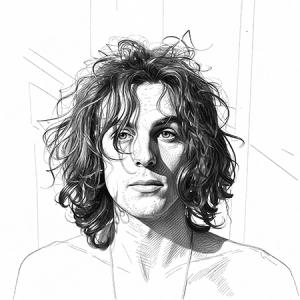
To my generation, the 70s era Pink Floyd, the band that brought us The Dark Side of the Moon, Wish You Were Here, Animals and The Wall, were a phenomenon – a multi-million-selling supergroup with globe-conquering albums. But we were also aware of an earlier incarnation of the band, the hippy group with whimsical album titles garnered from the pages of The Wind in the Willows, and with the legendary, lost frontman, Syd Barrett.
In Crazy Diamond, jobbing pub-gig rock singer Tony Riley is forced to look at his own situation, comparing it to that of Barrett, who shone brightly and briefly and was forced to walk away from the rock business in his early twenties. In this he also sees connections with the French poet Arthur Rimbaud, whose talent (and in his case, his life) also burned out young. Contemplating these figures, and also haunted by the death of an acquaintance years before, Riley must now face his own mediocrity. Is it better to have a brief, fleeting moment of genius, or to just plod along for decades?
Written by and performed by Chris Brannick, Crazy Diamond is a play with big concepts at its centre, with a flawed protagonist comparing himself against legends and finding himself wanting. The stories of Syd Barrett and Arthur Rimbaud are fascinating and tragic ones and the facts of their lives are well conveyed throughout. Brannick, as Riley, accompanies himself on the guitar, and the haunting, four-note riff of Pink Floyd’s ‘Shine On, You Crazy Diamond’ (written in tribute to Barrett) acts as an effective punctuation as he relays this information. The production’s currently a little rough around the edges, but given the fractured nature of the central character’s psyche, that is forgivable. I’m not sure, if the audience weren’t already convinced of their genius, whether the play would have converted them, but, being a similar age to the Riley character, it’s easy to empathise with his regrets at roads not travelled, and the recognition that you’ll never shine as brightly as your heroes, and it’s here that the play carries its resonance.
Robbie Carnegie
DR KOLFF AND HIS MIRACULOUS KIDNEY DIALYSIS MACHINE - Cul-de-sac theatre

This is the fascinating story of the man behind the invention of the world’s first successful kidney dialysis machine.
The format of this show is an interview with Dr Kolff, taking place in the 1970’s, assisted by his colleague Dr Bob Van Noordwijk. All actors had an easy natural style enhanced by not having a rigid formal script. This allows a realistic flow of conversation.
The interviewer, Mme Yvette Renaud, was non-medical which allowed the doctors to explain concepts to her (and us) in non technical terms. She asked about what led them to invent and develop the machine. There were a couple of fun demonstrations to explain the machine's function – one to show the principle of how Urea is taken from the blood and another using a mock up of the original machine.
The play was directed by Terry Naylor who himself is a patient undergoing dialysis; this added to the play’s authenticity.
In addition to the science and improvisation - they had to use American sausage skins (German skins were too prone to break) - they also had the political situation to contend with: this was 1943 and Holland was occupied by the Nazi’s. It is a telling fact that their first 16 patients died fairly soon after this new treatment but their 17th lived for another 5 years. Their dilemma was that this patient was a Nazi collaborator whilst Kolff and Van Noordwijk were both connected with the Dutch resistance. But, as Kolff said, ‘we are doctors first’.
Denied the Nobel prize three times Kolff and his family moved to the USA where he worked on developing the artificial heart.
There was a follow up discussion in the bar afterwards.
The play is about a remarkable life told in a bright innovative way. Do go and see it.
More performances Thursday 23rd and Friday 24th at the Conservative Club
Brian Kirman
FLIGHT: ONE MAN'S JOURNEY - Pricking Thumbs Theatre Company
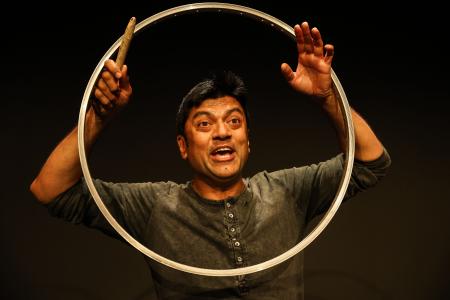
Flight: One Man's Journey is the story of Maneek's birth and childhood in Bangladesh up to his eventual settling down in England. Naz Sheikh plays all the characters we meet in this story (21, we are told in the blurb, although I didn't count!) including, of course, Maneek himself - and a tiger! Flight is structured as a tale told by a narrator: I wondered if the 21 characters might make it challenging to understand, but it was very clear throughout despite jumping between time periods and Maneek's ages. The narration is beautifully poetic, and there are some very striking images in the play. The tiger, who is introduced right at the beginning, forms a vibrant connecting thread as something Maneek is always either running from, or facing up to, like the Jolly Jackal in his aunt's story.
Flight plays with difference and exoticism. It begins with Naz playing an Ektara - a traditional one-stringed instrument - and singing in Bengali, and we are introduced straight away to stilt houses which protect from tigers, and teeth which are cleaned with crushed-up charcoal. However Maneek also finds the Manchester (where he comes to live) dialect strange and exotic, asking thoughtfully 'What language do they speak in Manchester?' So we are shown the strangeness from both sides.
There are some fairly heavy themes in this play, but it doesn't allow itself to stray into ideology. There are a number of comments on the position of women, beginning with Maneek's beautiful young mother (who gives birth to him at 15), and who has no power at all in relation to her harsh (and presumably older) husband. Ultimately their home will come under threat and the disgrace surrounding this will have lasting consequences for Maneek's own later marriage and where he can build his life.
Of course, the driving force behind the story is an exploration of immigration, and finding a home; and this is treated with a light hand. We are shown a perspective, and we are not preached at, which works very well. The play ends on a slightly equivocal note as we discover whether the tiger, who has pursued Maneek his whole life, is still there, alongside the impulse towards flight.
Naz does a wonderful job of bringing this all to life, and making the audience really see the scenes with very sparse scenery (basically a stepladder!), a few props, and an interesting but restrained soundtrack. His versatility and energy, and ability to convey place and atmosphere, along with a wonderful, lyrical script, really make this play. The audience absolutely loved Flight (and so did I). I think this is a Fringe must-see! On again 24th and 25th, 2:30pm.
Susie Halksworth
A FORGOTTEN WOMAN: MRS OSCAR WILDE - Slade Wolfe Enterprises Limited
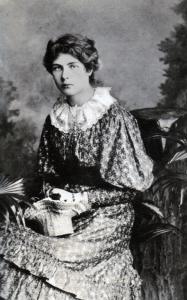
This was an utterly spellingbinding performance from Lexi Wolfe as Constance Wilde. Long eclipsed by her husband Oscar naturally, many are unaware of her existence but her letters show a keen wit and a desire that her life should mean something.
Her tale is told chronologically through her letters to her brother Otho. We hear about the death of her father, her mother’s coldness towards her, and we travel with her on her ‘should I marry or should I not’ journey. After all, according to her, she had ‘no beauty, no small talk and no charm.’ Going through a raft of unsuitable suitors, she strives to find her intellectual equal. ‘I have to marry someone brilliant!’ She ends up in conversation with an Irish gentleman and is definitely not bored, but charmed and delighted, as was he. We all know where this is going.
Constance is revealed as a writer, a celebrity in her own right, an early feminist and supporter of less restrictive clothing for women, corsets in particular. She was a prominent figure in the Radical Dress Movement which promoted softer and looser clothing for women allowing them to live fuller, less restrictive lives. She also strove to be a writer in her own right whilst admitting that she wrote Oscar’s work too, as he dictated to her. She did make some ‘alterations’ which made one wonder what exactly? So many women in history supporting men whilst losing their own identities and their own stories. Her struggle for her life to have meaning whilst bringing up two children mostly on her own and suffering with severe back pain was painful to listen to.
Lexi Wolfe brings the real Constance to life before our eyes. Her nuanced performance is sublime with every eye twitch or wry smile meaningful. She takes us on the exciting but ultimately tragic journey as we see the marriage begin to fall apart and can read between the lines of Oscar’s frequent absences. At one point Constance writes: He says he has forgotten our address. Probably one of the saddest lines in the show.
There was some fun use of props from her Victorian writing desk too as she used small plaster figurines to tell the story of a stay in a Scottish castle where she was pursued by several suitors one of whom was the son of the Laird much to his mother’s horror. He was only 16 after all.
This hour long, one woman show kept the audience enthralled throughout. Lexi’s ability as an actress meant that her face could go from shining excitement to tearful angst in a heartbeat. Her performance reminded me of the best of Alan Bennett’s Talking Heads. That ability to keep the audience engaged and enthralled with powerful acting and storytelling. Lexi has that in spades.
The eventual disgrace of Oscar drives her to Europe with her two sons. She changes their surname to Holland, sends her sons to school in different countries, eventually dying at 40. She refused to divorce Oscar remaining Mrs Constance Wilde to the end. A woman whose story needed to be told brought to vivid life in this production.
Moira Kean
GRANDMA'S SHOP - Julie Flower
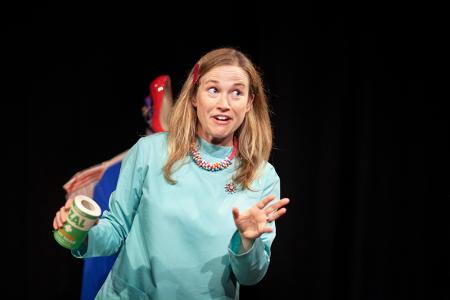
An endearing idea and tale: what lies behind a long-standing second-hand-clothes shop which predates the wealth of charity shops we see everywhere now? and who is the elderly woman who runs it to make money to feed some 30 cats?
We see Julie Flower in character(s) exploring her/their past and telling us the stories and about some of the characters who need those clothes – some of them up- and some down-market of the woman whose shop it is.
The woman is Flower’s grandmother, and we have the tale in flashback from different stages of the youngster’s childhood and onwards, from an innocent age 6 helping in the shop, and then as she grows older and comes to understand more about her grandmother and the wide range of customers and their manner and behaviours.
The context is that we, the audience, are members of a Family History group, there to learn about this family. Flower, in the show directed by Sarah Chew, presents to us as a lively open-hearted and friendly speaker, then breaks away into the set of characters, switching seamlessly from one to the next, back and onwards – perhaps more seamless and relentless than could allow for us to recognise all the individual characters and feel for them.
It feels like a well-drawn piece of social drama & writing: it was only at the end that Flower stepped totally out of character and, addressing us the real audience, told us it was all real: her gran, Aunty Hilda in Sheffield, had been a real person: the shop had been a real and much-loved shop. This is where the pace slackened and nostalgic warmth and humanity came through.
Michael Quine
GUARDIANS OF THE WYE - Two Left Hands
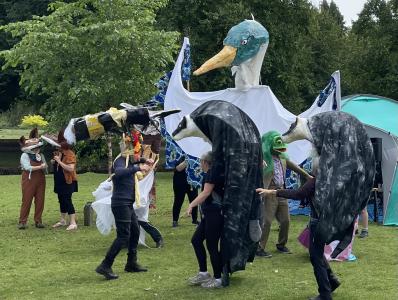
What a fantastic audience turn out for the first performance of Two Left Hand’s production Guardians of the Wye. The audience ranged from babes in arms upwards, such is the cross generational appeal of their work.
At the start the children were told to hang on to their grown-up if they were scared of the puppets. Not a chance! The young audience were wide-eyed and enthralled by the vast array of skilfully made puppets. A cheer went up as froggy appeared and everyone went awwh at the cuteness of mouse. We had wise spirits and a goddess of the water, and each character was puppeteered with skill and care. The puppets ranged from handheld butterflies all the way up to 3-person manipulation of Arnemetia.
The story was simple yet effective; an otter had found their way to the moorland and needed to get to the River Wye where it could live happily. An owl had also been displaced and went with the otter to find the river. Keeping our waterways clean for the wildlife and people was at the heart of this story.
The excellent 5 piece band were woven into the narration and they added a sense of fun and warmth to the puppets, with fantastic singing to really capture the attention of the audience.
What a gorgeous treat to watch Two Left Hands perform. Their group is a fabulous example of community theatre in action. Their puppets looked amazing in Burbage Institute, but I know they will look even more incredible outdoors, which is where their next two shows will be. Please come along with your children, it is a joy.
Jayne Fanthorpe Walker
HER RAVING MIND - Sweet Productions/tríada theatre
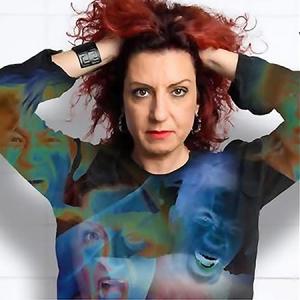
EL, short for Electra, is never quite good enough for her controlling mother, but this familiar scenario evolves into more sinister direct competition, as her mother apes her style and way of speaking. This Greco-British play references the Electra complex, a girl's competition with her mother over her father, so named after the Electra of Greek myth who murders her mother Clytemnestra, in revenge for the murder of her father Agamemnon.
The play is told via EL’s therapy sessions and in flashback, first to her childhood and her mother’s constant criticisms, with her mother’s eyes flashing on the backcloth looking down, and a voice that gets louder and distorts as EL is stretched to the limits of her sanity.
Later the flashbacks are to her 30s when she is making bad decisions and meeting bad men. The impact of that initial abusive relationship with her mother leading her to similarly damaging situations. Her routines, unchanged since childhood are her way to establish some control, but EL is only able to lose herself and find some peace when dancing to an impressive soundtrack of rave music, but it never lasts and she is overcome by her demons.
Fenia Gianni makes full use of the theatre space, occasionally coming off the stage to dance, or confront a man she feels has done her wrong, or most effectively to sit amongst the audience before being called forward in a group therapy session. Though it would benefit from a bit more light to counterbalance the shade, it is an intense and powerful performance that goes to extremes, much like the Greek tragedies of Electra.
Further performances: Tuesday 21 Jul 5:30pm to 6:30pm, Wednesday 22 Jul 4pm to 5pm
Stephen Walker
HOW TO BE THE PERFECT COUPLE - Randmade

Are we at a Fringe performance, or a lecture? There’s a lectern and a screen, and two smartly dressed business people. Perhaps we’ve misunderstood the programme and this is a book talk that’s part of the International Festival. But things don’t seem to be quite right from the start: the PowerPoint slides are wrong and the two presenters don’t seem to have agreed how to split up the material, or even where to stand. Cracks start to show in the relationship between Professor Robert Stenk and his wife Dr Veronica Stenk, who are here to give a lecture on how to have the perfect marriage.
Watching a play about a couple arguing might not sound very interesting, especially if you have the sort of friends that do this a lot anyway. But the dialogue in this play is superb, and the presence of the audience (we are there for a lecture, remember) keeps the tension under wraps, well most of the time. The changes in pace keep the performance moving, despite the very small space in which it takes place (and just imagine the horror of having a proper argument with your other half on a stage in front of a live audience). It’s also very amusing, and the audience was chuckling throughout.
John and Katie Rand, who wrote and perfomed the play, are superb actors. A real life couple, they met while studying drama at university, but this is their first production together and first performance at Buxton Fringe. John and Katie say they are nothing like Professor Robert and Dr Veronica Stenk but that the research they have done into marriage guidance has highlighted patterns which are familiar to everybody in any sort of relationship. And the show does have some helpful tips for managing conflict. So go and see this – you’ll be amused and learn something to make your life run more smoothly.
Two more performances 15 and 16 July, both 2.30pm – 3.45pm at Underground at Spring Gardens.
Georgina Blair
I ALWAYS WALK ALONE - Luke van Coot
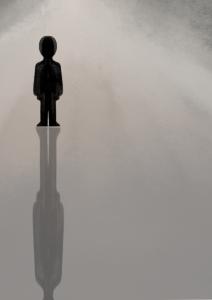
Set in 2040 when the ‘loneliness epidemic’ has driven individuals to both seek and abandon connection ‘I Always Walk Alone’ is a fable for our times.
Richard thinks he wants to embrace ‘sologomy’ and give up on finding someone to share his life with. He seeks support from Euphemia, the flawed ‘virtual navigator’ who takes him through a process offering ‘services that people want’ for a fee. Having declared that he ‘accepts himself, as himself, for himself’ Richard’s future changes when he accidentally meets another of Euphemia’s clients. In a world where it is possible to have no face to face interactions with anyone it can be easy to miss the chemistry that makes relationships work. Richard rediscovers the pleasure of walking with a companion, if only as far as the coffee shop at first.
The writer, Luke van Coot plays Richard, and Chess Slattery is convincing as Euphemia. The simple one hour production Directed by Rhonwen McCormack works well in the space at Underground Venues in the Working Men’s Club on Lightwood Road. They have two more performances on 9th and 13th July if you’d like to catch this thoughtful entertaining fable for our times.
Jean Ball
JANE: ENGLAND'S NINE DAY QUEEN - Prism Theatre
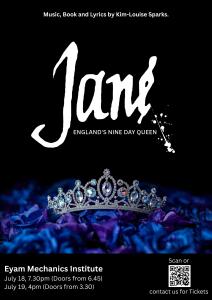
This energetic musical performed in Eyam is a real treat, casting a welcome light on an oft-forgotten historical figure.
The more we learn about Lady Jane Grey, the more we feel she deserves nothing less. This forgotten Tudor, the great-granddaughter of Henry VII, was a noblewoman and author who became Queen against her will, a pawn in an attempt to prevent the accession of her Catholic cousin, Mary Tudor. The tide turned and after only nine days she was deposed and taken to the Tower of London alongside her husband Lord Guildford Dudley. Mary was now in power but the story did not end there with both Jane and Dudley being executed in a bid to diminish the ongoing Protestant threat to the crown.
Writer and director Kim-Louise Sparks has delivered a fantastic script that imbues all the characters with realistic complexity. Mary is no simple villain, the men in Jane’s life are sympathetic yet frequently contribute to Jane’s unfortunate fate and Jane’s disastrously scheming mother only wants the best for her daughter.
Told almost entirely through songs, the musical is rich in memorable lyrics with the second half proving intensely moving as Guildford carves her name in stone during his imprisonment: 'Her name in stone, her voice in air, a fleeting breath, a whispered prayer…'
In the performance I attended, there were some issues with the music initially being too loud - something resolved in the second half. I’m glad about this because it was no reflection on the performers who really did project their voices. Chantelle Ruston made a fine Jane with her strong singing and characterisation and there was great chemistry between herself and Matt McAuley as Guildford. Indeed it feels like a passion project for the whole cast, which performs with emotion, intelligence and commitment.
After the musical ended, Sparks and the actors came out on stage and answered the audience’s questions about their historical sources. It was clear that it was not just the writer who was well-informed with each cast member fascinated by their role.
I strongly recommend you take yourselves to Eyam for the second performance today (Sunday) at 4pm.
Stephanie Billen
THE LAST THROW OF THE GUITAR - Clickers Theatre Group

A visit to 1973 was the order of the evening for this play. Along with the long hair and brightly coloured garments as sported by the members of the cast , the presence of an uninspiring and basically furnished farmhouse kitchen set the scene perfectly.
The aspiring rock group, The Blue Tolstoy's , have just appointed a manager to help them to hit the dizzy heights of fame and fortune, but most especially to, hopefully, secure for them the opportunity to appear on Top of the Pops!! Tommy Daniels ,the newly appointed manager, enters the stage wearing a bright orange tie and a Don Revie style of sheepskin jacket which every football pundit wore back in the day.
The story centres around this over confident and self opinionated manager booking the group as support act for the main stage at the Buxton Rock Festival that same year in July. This is to be The Tolstoy's promised big break. What could possibly go wrong ?!
This 45 minutes long play transports the audience into two worlds, that of the ambitious group along with that of a Derbyshire farming family.- and the circumstances of their meeting. The play was well cast with members possessing strong clear voices allowing the audience to follow the story easily.
A well written play taking us back into a less complex world , the Clickers Theatre Group do not fail to bring to the Fringe a good story which can be enjoyed by all ages - but holds special meaning for those old enough to remember this era.
Not to be missed, the play can also be seen on Sunday 19th July 7pm to 8pm at The Palace Hotel
Julie Alexander
LET'S ALL JUST TAKE A MOMENT TO BREATHE HERE - Susie Halksworth
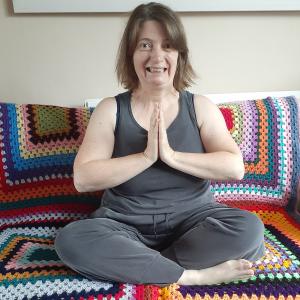
If you have ever been to a yoga class then you will be familiar with the gentle (well, mostly gentle) satire in many scenes in Susie Halksworth’s new play.
The show follows a class led by a weary teacher going through the motions and dealing with latecomers, members who didn’t know left from right, people in the wrong building and people coming to watch pole dancing.
Her branch of yoga is “Spiritually-Enhanced-Super-Fusion-Hatha-Flow”; designed, as the teacher reveals, to combine all aspects of popular yoga styles in order to get people in and make more money.
We are taken through breathing exercises, sideways stretches, downward dogs, cats and cows. The audience didn’t actually have to do the exercises but then neither did the instructor. We were led through ‘happy baby’ which apparently destroys your ego and we were reminded that the main objective of all this is to be able to ‘wipe your own bum when you are 85’. There was mention of Pranayama breathing but this was dismissed as ‘too advanced for Buxton. Catty remarks on expensive yoga pants and missing husbands were included and the instructor didn’t forget to try to sell yoga retreat weekends: only £400 but that incudes ‘Gong Bathing’ and a cup of Vegan Matcha tea on arrival.
If you are a yoga teacher then there may be good advice here on how not to run your classes.
Further shows on 9th and 20th July.
Brian Kirman
LIDO - A LOVE STORY - Lindsey Warnes

Do you remember those long childhood afternoons at the outdoor pool in summer? Lindsey Warnes takes you back there on her tour of some favourite Lidos in the UK and one in Europe. The heart of this show celebrates the joy of spending time in bodies of water. It also tells the unique history of each Lido which were created for a simpler time when we made our own entertainment and communities came together in the summertime to swim or paddle in woolen swimsuits.
Lindsay brings the Lido experience to life with gentle humour and a multi media experience ranging from family photos to seagulls swinging above the audience. She beautifully describes the social side of swimming including wanting to hang out with the older kids, flirting, romance and adult friendships. Her physical humour is delightful especially demonstrating the wide variety of ways that a towel can be used by Lido punters.
She evokes those unique swimming experiences such as the difference between swimming in sea water and sweet water, the difficulties of getting dressed when still a bit wet, swimming in the rain and the terrors of standing on the high diving board.
Lido is a show for anyone who enjoys gentle humour and a bit of nostalgia and especially those of us with fond memories of messing about in swimming pools.
Alex Watts
LIFE OF CHARLES - thecharleslloyd.com
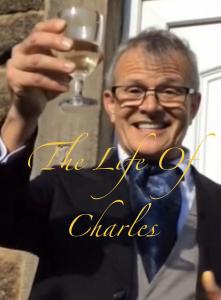
As energetic and enthusiastic as always , Charles Lloyd welcomed us to the cool green of his early evening venue at The United Reformed Church. Armed with memorabilia from his past career as an actor and performer as well as that of a Stage and Company Manager, Charles took us on a whirlwind tour of thespian globe trotting interjected with a directory of famous household names.
Charles interspersed his lively commentary with songs from the eras he talked about, this included a punk rock rendition of Nellie the Elephant to an uplifting song from the musical Chicago. Charles was a non stop one man show with a tale to tell. Well, several actually !!
Armed with his props of a bed of nails and a Town Cryer's coat, Charles Lloyd demonstrated the art of pain resistance and told of a welcome lucrative money earner in early lean years. The story of being runner up at an audition to a man who would become a future stage and screen icon was told with pride!
With a warm manner, this performer takes his audience along with humour and good cheer whilst relaying stories of shows based both in this country and abroad. Starting with the day he was born in a picturesque Dorset village whilst his father went to buy a fish and chip supper, it is apparent that Charles came into this world with a speed he has never lost!!
Charles's love and affection for the theatre and his theatre family of bygone years was demonstrated throughout the evening. The audience came away acknowledging this man's overwhelming passion for his art and his determination to entertain.
The next show will be at 7pm on Saturday 11th July
Julie Alexander
LOADING... - Ed Sumner, Magician
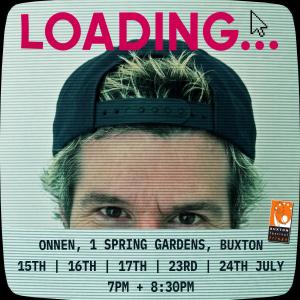
Loading… proposes an intriguing mix of magic, comedy, storytelling - and even some insights into the meaning of life. Ed Sumner pulls off this combination with relaxed charm.
This is a magic show performed as a story, beginning with Ed’s youthful fascination with arcade games. To start the show, the audience needs to insert 50p into a slot in one of Ed’s fun cardboard props. Luckily someone still carries cash and obliges. The 50p disappears and later ingeniously reappears, in one of Ed’s mind-boggling feats of close-up magic.
Intergenerational differences is a theme, which works well with this mixed-age audience. Ed cleverly uses nostalgic, retro electronic devices in his mind-reading, deftly combined with smartphone technology. Rubik’s Cubes make an appearance, an audience member being enlisted to help with a gasp-inducing trick.
Slapstick is also part of the performer’s repertoire. On hearing an audience member was born as recently as 2008, he literally falls to the floor in shock.
There is standing room only at Onnen, the intimate atmosphere perfect for this show. Ed has nowhere to hide as he flawlessly performs close-up magic. Jokes and tricks elicit laughs, wows and applause. Ed interacts easily and confidently with the fully-engaged crowd.
This is a pay-what-you like show, very much worth a full ticket price. True to his ethos, Ed accepts old-fashioned coins and notes, or you can tap a card to contribute.
Ed suggests that we might use those in-between ‘Loading…’ moments to connect with each other. He achieves just that by bringing us together in an enjoyable, communal experience.
There is one more performance of Loading…, at 7.00 pm on Friday 17th July at Onnen.
Damian Payton
MACBETH - Buxton Opera House Creates Work Experience Company
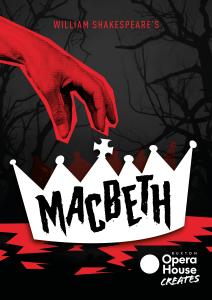
Who knew Macbeth could rock a punk outfit and green highlights?
This abridged performance of Macbeth, performed by the Buxton Opera House Creates Work Experience Company, is the product of a ten day process. Yet, with such little time to learn lines, choreograph dances, and design this show (from costumes, lighting and sound), the young cast and crew pulled off Shakespeare like they'd been doing it for weeks.
Heading into the venue, stepping under bunting made from hanging scrap fabric, the cast await on a graffitied floor, around a glowing circular light. In their punk rock fits, including: denim jackets emblazoned with their character names; scraps of tartan safety pinned everywhere, and various neon coloured hair highlights - the group are jovial and chatty, waiting for the room to fill up. With a nearly full audience, we were treated to forty-five minutes of rock music, dance choreography, Kate Bush-esque witches, and the Shakespeare tragedy we all know and love. (And no Macbeth production would be complete without a neon stained Scottish flag, to wave over the body of the aforementioned Scottish King.)
An abridged version of the original (which is usually over 2 hours), the story was concise and moved us quickly through the tale, taking us on a whirlwind tour of Scottish kings, bloody battles and good old fashioned murder. What really made this performance stand out was how clear it was that the cast and crew were very much enjoying themselves.
They brought high energy and a dedication that is so needed to turn a show like this around in such a short time. With the production sold out for its remaining three shows, if you were able to grab a ticket, you are in for an energetic rocking experience, with a group of young people interpreting Shakespeare their way.
Amy Powell
MATR[AI]RCHY - Shadow Syndicate
Imagine a world where a new AI program, Sincerity, has been created which has reversed centuries of patriarchy at a stroke. This program has created a world where men no longer have an assumption of superiority, where male-on-female violence no longer goes unpunished. Is this a feminist Utopia, or is there something more sinister and personal at play?
This is the premise of Shadow Syndicate’s bold, challenging new production, Matr[AI]rchy, presented in their trademark, committed, physical, visually arresting style. In a series of separate vignettes we see the impact Sincerity has on lives – giving a woman the chance to re-edit her conversations with her controlling partner, an older woman suffering from dementia the memories of her marriage that she had lost, a grieving man the ability to keep his partner alive after death, and forcing a woman to re-experience a sexual assault in order to definitively prosecute her attacker.
It’s a strong idea, and as always Shadow Syndicate deliver it expertly. The individual performances are all excellent (I especially found Esther Pile, as Sincerity’s inventor interesting, in her depiction of the complex motivations of this ambiguous character), and there is a fluid physicality to the work which is slickly choreographed throughout. However, the emphasis on brilliantly executed movement can have its costs. Most of the scenes feature moments of violence which, well done though they are, felt troubling at times. It’s always a tricky thing to negotiate – by depicting violence in a visceral, realistic way, are we condemning it in all its brutality, or somehow glorifying in it? It’s not something to which I have an answer, but in this show, it definitely gave me pause for thought.
There’s no doubt that we live in scary times, and that sense of danger must be doubly felt by younger people who will need to live in the dystopian world we have created. Matr[AI]rchy, with its bold sci-fi concept at its heart, recognizes this situation and replies with a bleak nihilism that doesn’t make it a comfortable watch. But maybe that’s the point? Shadow Syndicate have to be commended for their skill and professionalism, and also for their ability, easy on the audience or not, to look into that heart of darkness.
Robbie Carnegie
'MY MOTHER SAID I NEVER SHOULD' - The Pendleton Codebreakers
You do your best for your daughter then you find out it’s not what they wanted or needed.
The grand setting of The Palace ballroom could have overshadowed a lesser play, but this is a Charlotte Keatley classic, beloved of sixth forms the county over for its strong female characters and its exploration of mother-daughter bonds.
It is a challenging play for young performers to be able to grasp the physical and emotional complexity of the aging roles. However, this cast understood the nuance and were able to do this play justice.
Darcy Cassidy maintains Doris’s unique individuality masterfully through vocal and physical skills that remain consistently strong throughout her thoughtful performance. The old lady make-up was unnecessary as her acting skills faithfully carried the part.
Lillia Duguid effectively used her physical skills to show an increasingly uptight woman who is battling to maintain composure. Margaret is trying to be the rock for her family both emotionally and financially. Lillia is an interesting actor who is very watchable. Noisy shoes were a distraction though.
Evie McElroy plays Jackie who is a tricky character as she wants love but feels unworthy. Her decisions change the mother-daughter relationship and send ripples through the whole family. Evie makes us feel real pity for the character as she inhabits a character who is maturing and feeling the weight of her decision.
Lilly Peppard is the youngest character, Rosie. Lilly plays the character with full enthusiasm and energy. She is fully believable at all ages her pitch of voice never becoming an irritant.
The transitions were an issue; they were slow and clunky and slowed the pace of the piece. The venue’s limitations clearly made quick costume changes difficult, but more inventive staging might have eased these moments. The sound tech was a bit too loud and often overpowered the voices on stage, which at times could have benefited from greater projection.
Overall, a great production with strong performances.
Jayne Fanthorpe Walker
THE NIGHT HAS MANY EYES - REC Youth Theatre
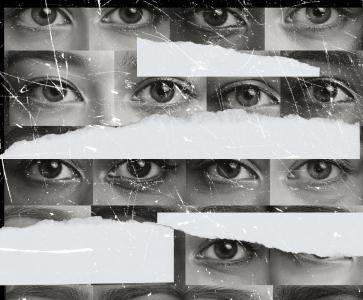
What an unexpected joy to see a youth theatre group put on a comedy performance. Buxton’s own REC Youth Theatre’s performance of The Night Has Many Eyes was a sketch show which saw the young actors perform a variety of short scenes to the delight of the audience.
Scenes flowed smoothly with some great punch lines to end each section. The audience were laughing out loud at some of the endings.
Using the classic dead parrot sketch was a bold move but some young people who hadn't heard it before were giggling away in the audience.
The girl's sections were more precisely crafted than the boys and seemed less freewheeling. Pace was lost occasionally when the actors got carried away. I loved the sketch featuring the annoying girls in hell. In this scene all of the actors completely captured their character, the pacing of the comedy from the young performers was excellent. It was genuinely a fantastic piece of comedy.
Actors were sitting on stage, so that scenes flowed quickly from one to the next and it was a good decision. However, a word to the actors if you go wrong, don't show it, if you're bored, don't show it, the audience can still see you.
Comedy is a difficult thing to get right, especially for young people, the lightness of touch and the total conviction needed to pull it off are much more complex than they appear. REC Youth Theatre have shown they have funny bones. Well done!
Jayne Fanthorpe Walker
OFFGRIDLAND - Paul Richards
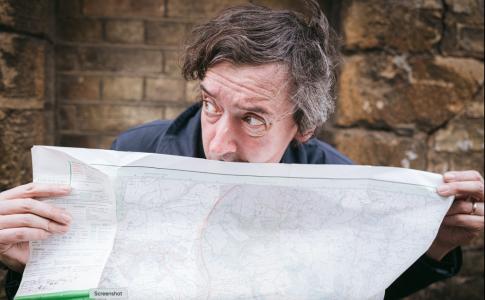
The modern world is a busy place with constant demands on our time and attention. Kevin needs to unwind at lunchtime so much that he has a name for it - Offgridland.
Just a precious hour with no distractions, when he can relax and have something to eat and just listen to some music. Today he needs it more than ever, he’s had a horrible experience on leaving the office, he’s convinced he’s going to get fired, and that his girlfriend is going to dump him.
Of course, he is never going to get that break. If it’s not the phone, it’s the laptop, or the smartwatch with health warnings, or the neighbour, or the pizza delivery from last night. There’s a relentless series of events disrupting him from the cereal bar he just can’t open. The pace is high, and series of sound effects is worked in seamlessly as Kevin reacts ever more frantically to the interruptions.
Writer Paul Richards as Kevin is suitably gawky and manic, bringing a nerdy fish out of water nervous energy to the part, but the show needs some changes of pace where he allows Kevin to slow down and get a glimpse of that relaxation he so desires. Before ripping it away again of course.
Kevin’s predicament is a scenario we can all identify with, maybe you can catch an hour’s Offgridland with Kevin at two further performances at Underground at Spring Gardens perfectly scheduled at lunchtime 1pm Mon 20th and Tues 21st July.
Stephen Walker
ONLINE PRESENCE - Hard Times

John Arthur Sweet won the Spoken Word Award at Buxton Fringe in 2024 with his autobiographical piece ‘outside, in the laneway, under the stars’. This year he returns with an intriguing one-man play, addressing one of the biggest questions of our time.
The action opens in a sparsely furnished flat. A man is looking out of the window, watching removal men at work at a neighbouring property. He too has to go somewhere, but first he’s going to explain why. This is a beautifully constructed piece, only gradually revealing the strangeness of the situation. The man’s gentle style of delivery contrasts with the dystopian future he’s describing. There’s even a hint of romance.
And is he really describing the future, or is it here now? How many of us are living our lives online, posting furiously about the performances we’ve seen and the parties we’ve been to? But the show does offer a glimmer of hope - the man, and the audience, both leave hoping that there will be a happy ending.
What’s certain is that attending a Fringe performance is the antithesis of living a life online - make watching this show your act of rebellion against big tech.
Next performances 24 & 25th July, 1pm to 1.45pm (Underground at Spring Gardens)
Georgina Blair
PAYWALL - Neysa Killeen
Paywall was performed in Beer & Bean, which is a great venue (with a dedicated stage, and I was able to enjoy a very nice flat white while I was watching!), but which had a few noise issues on the night I attended - traffic, loud customers, crying babies etc. Neysa Killeen, who wrote and performed this one-woman show, really deserves an enormous amount of credit for not only keeping going, but being apparently unfazed through the first twenty minutes or so. It must have been quite difficult, because Paywall involves some complexity - quieter scenes, thoughtful silences etc - so she couldn't just bellow over any background noise. If Neysa can act through that she can act through anything - Paywall will really shine in a dedicated theatre.
Despite these initial issues, which were resolved, Neysa brought a strong, sensitive performance to some interesting and complex writing. Paywall is about a girl, Lizzie, growing up to (try to) become a journalist, and touches on a lot of themes: the death of her mother, the relationship with her father and sister, difficulties with starting on a career after university, nepotism - and some darker ones too. At one point, Lizzie stands up and says 'normally, I know I am right about everything I do': the play is partly about her struggle to maintain and assert this knowledge, and it does this very well.
There were some nice touches: the solidity of the physical dictionary in the early part of the play, representing words and their effects, worked well, as did the physical presence of the cardboard packing box. The scene around Arthur being bullied at school, and the bullying being exposed by Lizzie in a newsletter, making the audience think about the power of journalism (but did it make Lizzie a bully herself?) was well thought out. The scene with the recorded interview between Margot and Lizzie, with Lizzie typing up a slightly different version of events, was well done: along those lines, the unacknowledged mother-substitute relationship with Margot and the ambiguous relationship with her sister Caoimhe were both convincing. The nepotistic gatekeepers of the university journalism society would be familiar in one form or other to anyone who has been involved in student journalism, arts or politics; and likewise the focus on follower numbers/going viral.
The play ended on a deliberately uncertain note, which was well done: although I think we were all convinced that Lizzie would become a journalistic force to reckon with. A strong, thoughtful play - this was a one-off performance at the Buxton Fringe, but Paywall will also be going to Edinburgh.
Susie Halksworth
POCKET PIRATES - Utopia Unlimited

Sometimes it’s the amateur productions that just hit you in the gut when you weren’t expecting it and that was the case this afternoon at the first performance of Pocket Pirates by Utopia Unlimited.
Utopia Unlimited is a not for profit youth theatre group which operates across the High Peak offering 8-21 year olds theatre opportunities and specialising in Gilbert and Sullivan. As an unabashed G&S enthusiast, it was lovely for this reviewer to see people under 60 throwing themselves into the G&S world with such gusto.
The show got off to a rollicking start with the entry of the pocket pirates and their pirate ship trundling through the audience singing their hearts out with the rousing chorus of Pour Oh Pour The Pirate Sherry! The audience was with the pirates right from the start.
This version of Pirates was pocket sized, lasting just over an hour. All the old favourites were still there of course, 16 year old Adam Kingston performed the iconic Major General’s patter song with confidence and aplomb and was practically word perfect. He looked and sounded the part too, his voice and acting skills perfectly suited to this challenging role.
The cast of 12 ranged in age from 8-21 and 8 yr old Bob Hale was thoroughly enjoying every second of his performance even when he wasn’t exactly sure where he was supposed to be going, he gamely carried on singing and dancing with a big grin on his face. Even whilst sporting a doughnut around his police truncheon.
Bob’s older brother Tom as leading man Frederic was clearly his inspiration and despite sporting a broken arm, sang his heart and soul out. Tom is also the show’s very able choreographer.
Karl Morewood as the Pirate King relished his role, singing out with a lovely bass baritone voice whilst trying to control his hat. He was ably supported by four and a half pirates who very clearly really enjoyed what they were doing. One pirate even managed a very funny Trump impersonation. I’m pretty sure Arthur Sullivan would have approved.
There were some lovely voices amongst the girls, most notably Oli Davey as Mabel who managed to hit all the high notes in Poor Wand’ring One. There were some delicious ironies of course with 15 year old Philipa Morewood as Ruth having to be described as plain and old.
This was a charming and wonderful production which touched everyone in the audience. The cast were totally committed to the wonderful world of silliness and sharp comedy that is Gilbert and Sullivan. Long may they continue!
Moira Kean
A PUNK OPERA - Nuworks: theatre made in Australia
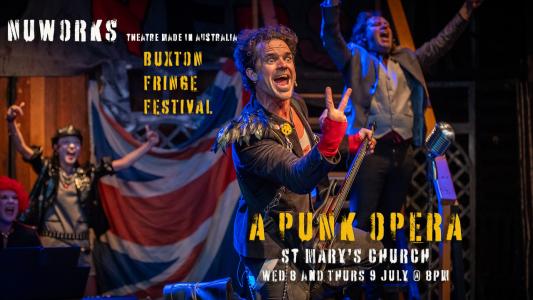
Many of the audience eagerly anticipated the return of the award winning Australian company, Nuworks Theatre after their production of ‘The Shoemaker of Havana’ 2024. In fact quite a few also attended their earlier performance that evening of ‘This machine kills fascists’.
Your reviewer only attended ‘A Punk Opera’ and was certainly rewarded with an enthusiastic and committed performance.
Neither opera nor musical, this is a play with songs, as was the inspiration behind this production, John Gay’s ‘A Beggars Opera’ written in 1728. Bertolt Brecht was also influenced by Beggars Opera to write ‘A Threepenny Opera’ with music by Kurt Weill. This production incorporates the satirical nature of the original writing along with the theatre style of Brecht.
Set in Thatcher’s Britain of the 1970’s with the emergence of punk as a reaction against the political and social status quo, we follow the story of deception, double crossing and bribery of our anti-hero and his relationship with a dysfunctional family.
We saw a strong cast of nine, each having a character role, with three doubling as keyboard and guitar musicians to support the saxophonist. All cast members sang in the ensemble numbers with energetic choreography typical of the era. There were also some solo numbers.
The script included clichés, slapstick, humour and thought provoking soliloquies – unfortunately, sometimes lost through lack of clarity of delivery. However, a grand dénouement (spoiler alert!) provided a satisfying conclusion to a thoroughly entertaining performance.
Although it is possible to find some additional information about the production through the depths of an Instagram posting, no cast list was available to mention individual performances, in particular the outstanding characterisation of our main protagonist.
There is a second performance in St Mary’s Church 8pm Thursday 9 July and Nuworks Theatre two week tour closes with performances in Greater Manchester Fringe on Friday 10 July.
Carol Bowns
ROGUES' GALLERY - Black Liver

This excellent, packed production deals with multiple aspects of modern life usually from a woman’s point of view.
We have a woman who hated being wolf-whistled when younger and prettier but now misses it as she ages and no longer catches men’s eyes. She compensates by life-modelling for an art class.
There is ongoing correspondence between twin brother and sister: one of whom has ambitions to be a successful painter and the (more talented) sister who is suppressed by their father and ends up in a psychiatric hospital.
There is also a feminist quiz show where the answers to questions such as When did women get the vote? and When was the contraceptive pill made available in UK? highlight the painfully slow emancipation of women in the UK. The quiz was presented as a bit of fun with the female contestant verbally abused for ‘mouthing off’.
There were also hints at a lesbian relationship between the main female character and her maid, Poppy. But the central theme was a mysterious painting of an unnamed woman. She dominates the gallery with myths and fantasies being attached to her by gallery staff and visitors. She is said to cast a malign spell if abused. The stories attached to her are foreboding and mystical.
So a lot to get through in this play but it is saved from being heavy and didactic by the light, humorous touch of Ruth Cockburn and Keith Carter.
A fun and thought provoking hour.
Further shows 17th and 25th July
Brian Kirman
SADOMASOCHISM FOR ACCOUNTANTS (IN CONCERT) - Ashgate Heritage Arts
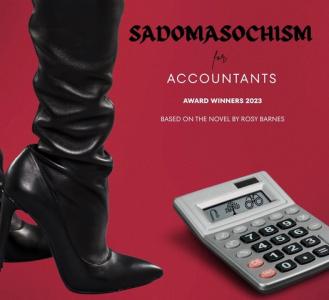
For a number of years, Ashgate Heritage Arts have been coming to Buxton Fringe with one of the rarest of theatrical offerings, new musical theatre pieces. These have covered subjects such as Chesterfield’s twisted spire, and the adventures of a group of animals looking for water. For this latest, very assured piece of musical theatre, they move into more adult territory.
In Sadomasochism for Accountants, we meet Paula, a downtrodden young woman still reeling from being dumped by her accountant boyfriend, Alan, on the grounds of being too boring, sexually. Alan has quickly moved on and now has a scarily ambitious fiancée, Belinda. Meanwhile, Paula, in her desire to broaden her sexual horizons, decides to visit a fetish club, where she is taken under the wing of the club’s resident drag queen, Luda, and its other, colourful denizens.
The show is presented in a ‘Concert performance’ style. For those not familiar with that as a concept, it is one often employed in musical theatre when the resources are not there to mount a fully-staged production, or to try out a new work, and this production is an ample demonstration of its strengths as a form. There are music stands with music and words on them, there are microphones on stands, but the four-strong cast are more often away from these. Under the direction of Frazer Meakin, the space upstairs at the Old Clubhouse is cleverly utilized as the actors move around and through the audience, and minimal props, costumes and microphones are wittily employed to tell the story.
All four performers – Ella Maria Danson as put-upon Paula, Drew Sinclair as the arrogant Alan (but also the sweet, shy Fred), Alex Aram as Luda and Georgie Maria Rodgers as the scary Belinda (and Eastern European dominatrix Gretchen) – are very accomplished. Danson especially, has a wide-eyed energy that is very enjoyable to watch. Although the scripts were a feature of the show, they largely didn’t need them. However having an interval seemed to take away some of their momentum, and the second half was slightly less confident than the first.
Writers Martin Coslett and Tim Leichtfried have crafted a great selection of catchy, infectious songs and larger-than-life characters, and the plot rattles along at a brisk and fun pace. I’d be tempted to lose the coda at the end of the show where the action is rendered by sound effects alone – it leaves a slightly bad taste (something slightly acknowledged in the in bows afterwards). That said, I think Sadomasochism for Accountants definitely has legs as a show, and I look forward to seeing what its next steps will be.
Robbie Carnegie
THE SPACE BETWEEN HEARTBEATS - Triple Threat
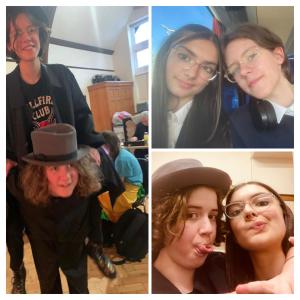
The Space Between Heartbeats is a piece of new writing, written and performed by the trio 'Triple Threat' at the Buxton Working Men's Club. Originally due to be performed outside, the trio had adapted well to the venue change, and made good use of the stage that is featured at the club (with more chairs having to be pulled up for the audience, due to the good turn out).
The play itself follows a dysfunctional friendship group and the fall-out that happens when one of the members suddenly dies. The friends left behind are the two on rockier terms, and over the duration of the show, they learn how to get along (accompanied by the ghost and memories of their deceased friend) and learn how to grieve and move on without her.
The play was a swift fifteen minutes and performed confidently by the young actors, and it was interesting to see them choose to explore such an emotionally intense story. Though the play was short and quick paced, it may have been nice to linger on characters and perhaps allow them to monologue, so each young actor could further show off their skills, and help us learn more about the characters. They condensed a sad, but overall heartwarming story of friendship, love and forgiveness, into a play that didn't require anything like elaborate sets or props, just good and honest dialogue.
They did very well for their first ever performance, and the audience loved it (with perhaps a tear or two, shed). As this was their only performance of the Buxton Fringe, I hope to see the trio continue to write and act together, and it would be great to see what they might produce for future fringe festivals!
Amy Powell
TELL ME WHERE IT HURTS - Teepee Productions

Two years ago, Tayla Kenyon and Tee Pee Productions brought ‘Fluff’, their multi-award winning show about dementia, to Buxton Fringe. Where it promptly won another award.
Now the same team is back at the Working Men’s Club with their next production, Tell Me Where It Hurts, a comedy drama about Chrissy, a woman suffering from pre-menstrual dysphoric disorder.
On paper, this looks to be a harder sell than Fluff. Awareness of PMDD is minimal, despite nearly a million women in the UK alone suffering from the condition.
But Tee Pee Productions have created a belter of a show that also just happens to highlight some fundamental issues. Chrissy is the roiling, pulsing heart of the story while the other two performers convincingly juggle the remaining roles between them.
Chrissy’s story is compelling - and wearily familiar. It is a story of, not so much women’s invisibility, but their inaudibility. Chrissy is surrounded by pleasant people who say they want to help her but who somehow never really listen to her. Again and again and again. Whilst routed very much in Chrissy’s present, the play looks both backwards and forwards to illustrate this inaudibility and suggest the consequences that it has had before and may have again. And somehow, through all this, it is still very funny.
The cast of three perform wonderfully, with the two supporting actors dancing nimbly around the focal point that is Chrissy. The clever production makes excellent use of the small space.
Tell Me Where It Hurts is an enthralling show that will take you on a helluva ride. There are three more performances in Buxton before it goes to the Midlands. It’s a terrific way to round off this year’s Fringe. Don’t miss it.
Anna Girolami
THERE IS A LIGHT AND A WHISTLE FOR ATTRACTING ATTENTION - Play Nicely Theatre
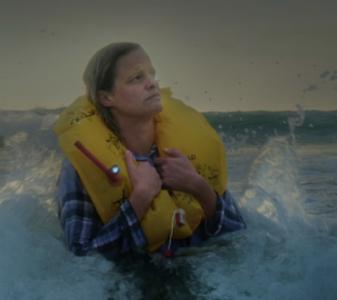
This is a total success: from the wise, intelligent and beautifully-phrased and developed script, through a performance which moves through the vocal range while using but never over-using the full stage area, and with a setting which starts as just a chest of drawers but is used inventively to hide, unhide and hide again the items which create the memories which drive and undermine the character.
From start to finish, Henri Merriam fully owns and has complete control of her script and delivery, with perfect and respectful timing of movement and pause. The delightful script is (almost) book-ended by telling phrases: we hear early on that she reckons she has been suffering from “relationship hypochondria” and that when the truth about her long- failed relationship hits home, the bomb hits “but there was already a crater”.
It’s the story, starting from the innocence of childhood, of one woman’s expectations of the perfect loving relationship, going right through to marriage with all the baggage of the empty classic pre-wedding rituals and the assumptions about having/not having children: and then irretrievably onwards to the total breakdown of the partnership with his control, gaslighting, and her realisations, fear and thoughts of suicide – or would it be murder instead?
It’s a one-woman show, with other people represented either by extracts of absent husband Tom’s recorded voice or by Merriam’s voicing what could be friends or simply memories of those friends, not to mention her brief moments with the unhelpful “Relationship Advisor”.
Directed by Sophia Capasso, it’s remarkably good-natured, lively, exhilarating. A triumph. Seen here in Buxton a couple of years ago and an award-winner then: now poised for a short London run in September.
Michael Quine
THIS IS YOUR LIFE (WORK IN PROGRESS) - Chris Neville-Smith
20 or so years ago novelist John O’Farrell published 'This is your Life', a skit or satire on aspects of modern life, on celebrity culture and how we respect 'celebrities', on how fame develops, on what matters, on how - for an individual (not least a nonentity) - it need not take much for people to get – and develop – ideas about them above their station.
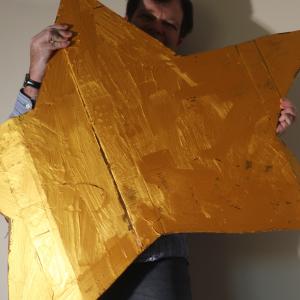
In this show, seen at the Cheshire Cheese pub (one of a small number of shows at this venue), we had the first performance of a work in progress, adapted and performed by Chris Neville-Smith, in which he tells and shows how a nonentity becomes a well-respected star and stand-up comic. The narrative takes us back from a potential brilliant public performance event, and through the series of inventions, lies, and accidents which led a humble languages teacher astray.
It’s a complicated story which engages with a number of characters presented by Neville-Smith differentiated through a change of tie or jacket, though more could have been done to separate the characters from each other, as we see and hear story rather than character. There is a lot of detail to keep hold of though the satirical elements are made explicit at the end.
There is an 'immersive' element which involves some audience members being asked to read a few lines of script for their character: and one invited on stage to pretend to ad-lib in context, which made a welcome change of pace from the performer’s relentless energy.
This initial performance was presented as a ‘work in progress’ and audience members were invited to comment and discuss afterwards before the show goes on to its second preview in Durham at the end of the month.
Michael Quine
THIS MACHINE KILLS FASCISTS - Nuworks: theatre made in Australia

Two years ago, I was fortunate enough to see this company’s award-winning show ‘The Shoemaker of Havana’ telling the story of the Cuban missile crisis, which was in my option worthy of a West End stage. So, I was very excited to see the company return to Buxton this year with two new shows. My expectations were also very high and I’m pleased to say that Nuworks did not disappoint.
In this production the company have turned their attention to the life and times of American folk singer and civil rights activist Woody Guthrie.
Guthrie’s story is presented via music, song and narration, with the 9 strong cast playing Guthrie and the people who knew him best; his mother, various wives, his friends and fellow musicians.
Starting with his early childhood with his mother suffering from Huntingdon’s disease and his absent KKK activist father, the hardships of the great depression ignited his passion to be the voice of the working man against the small white male elite who ran America. Guthrie was a fierce proponent of the civil rights movement, and fought against the threat of Fascism from Hitler.
The narrators present a passionate and talented man but a flawed one, his attitude towards women, failed relationships and drinking are set against his talent and sense of equality and fairness. He used his music to give a voice to the voiceless addressing labour disputes, attacking inequality, discrimination and fascism, famously painting the slogan “This Machine Kills Fascists” on his guitar.
This is a highly professional performance, the cast all have excellent voices and bring energy and movement to the show while using the challenging space very effectively to deliver brilliant storytelling.
There is one more chance to see this show on Thursday 9th July at 18.00 – don’t miss it!
Carole Garner
TRIO - Sheffield University Drama Society
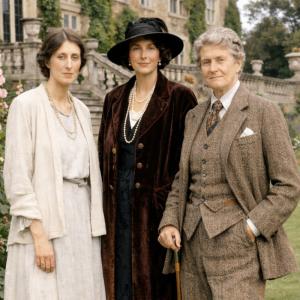
This play gives us an entertaining insight into the relationships between three prominent female creative artists in the first half of the 20th century. We see composer Ethel Smyth, author Virginia Woolf and author and garden designer Vita Sackville-West through snatches of conversation, and excerpts from their letters to each other, which were frequent and sometimes lengthy (what it was to have a postal service that would deliver several times a day).
All three women are played convincingly with their different characters well demonstrated. Ethel (Alison Munro) is strident and no nonsense, while Vita (Anne Padget) brims with life and sophistication. Virginia (Chris Heery) is more reserved, and forms the still centre around which the other two revolve. We get insights into the suffragette movement; Edith was a wholehearted supporter while Virginia was more ambivalent. References to Virginia’s published works show how she was influenced creatively by her relationship with Vita.
This play was written and directed by Ian Gledhill, and presented by Sheffield University Drama Society (SUDS). It’s great to have SUDS back at the Fringe and this is another interesting well-performed piece which was very well received by the near capacity audience.
There are further performances on 21 and 23 July, both at 4pm - 4.50pm in Underground at Spring Gardens.
Georgina Blair
THE TRIPLE BILL - RoTo & the Three Wise Monkeys
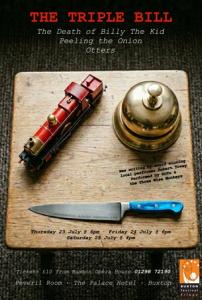
Robert Tovey is a Hope Valley-based actor, who has appeared in the area in various productions, but here returns to Buxton Fringe as writer-director of a very pleasing trio of short plays.
In the first, The Death of Billy the Kid, Tovey himself plays Bill, middle-aged and regretful of his life choices, looking back on his hopeful childhood, as he himself contemplates taking his own life. Meanwhile, Emily Somerton plays a woman with whom this decision is linked, in a way that provides the play with a small twist midway through. It’s a simple idea, simply staged, but consistently acted throughout.
A quick set change, and we’re off to the second play, Peeling the Onion, the longest, and probably most rounded of the three plays. In it, the consistently entertaining Nick Wardle and Louise Whiteley play a succession of characters attending a speed-dating evening. To facilitate the move between the characters, they begin with multiple layers of clothing which are gradually whittled down as the play progresses. We see some very funny comic characters, including nerdy pedant, scary taxidermist and obsessive serial fiancée amongst them. Arguably we could have had one or two less, as the idea has been well worked out by the time we reach the last iteration (and last layer of clothing), but this is nonetheless the standout of the evening.
The final play, Otters, presents us with two blood-soaked, knife carrying women (Somerton and Whiteley again) chatting amiably in the aftermath of whatever crime has brought them to this point. Clearly it was not for any gain, as they are calmly waiting for the police to arrive. We never get to find out the reason for what they’ve done, or where the blood comes from, instead what we have is an almost Tarantino-esque juxtaposition of violence and mundane dialogue, well conveyed by both actors. In this, once again, Louise Whiteley, proves herself an extremely able character actor.
This trio of plays shows Robert Tovey to be an interesting writer with an ear for dialogue and for intriguing situations. There’s a definite linking tone of voice between the three plays – he has a robustly masculine sense of humour throughout – and he clearly has an ear for what resonates with the audience. As a Triple Bill, the three plays work well. I might have been tempted to cut out the curtain calls after each play, and the interlinking chat from Tovey, but I appreciate these might have been necessary given the need to cover costume changes etc. All in all, this Triple Bill is a great calling-card for a writer, and a company that’s worth watching as they develop.
Robbie Carnegie
UNLEASHED - By The Bi Productions
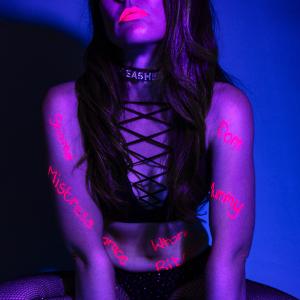
Unleashed is a new piece of theatre by Siobhàn Healey, who also stars as the Dominatrix, with Nathan Dowling directing and also co-starring as all the other (male) characters. It's at Underground at the Working Men's Club; the stage set up there was used well, with relatively restrained sound and lighting effects which conveyed scene changes very effectively.
Unleashed explores issues around BDSM and sex work, but also politics, social context, and individual emotional reactions around these things. The play involves Siobhàn, in her role as Dominatrix, educating the audience in how to take part in BDSM, and before I saw it my concern was that it might be a little bit didactic. But I was quite wrong: Unleashed is an engaging, complex play (especially given its short length), which moves very fluidly in between various scenes, and from realism to something a bit more meta.
The Dominatrix announces at the beginning her intention to create a safe space, but to unsettle us (which was a great use of theatre to enact the play's theme); and this is certainly what Unleashed does. There is quite a bit of audience interaction (so be aware), but everything is done respectfully, in a well-controlled way, and with good humour.
The show begins with Elvis the slave playfully bringing members of the audience on stage to show them how to clean and put condoms on a series of dildos, which was funny and effective, and drew the audience in: then the arrival of the Dominatrix introduced emotional complexity through her interactions with various of her clients, and the audience. At the same time as educating us on how to engage with BDSM, we are shown her backstory; a difficult childhood, and a fractured relationship with her daughter. I thought the scene where the Dominatrix pleads with her daughter was particularly well acted.
Nathan, as well as playing Elvis the silent (but very perky) slave, plays a number of other clients (who do speak!), which is quite a tall order, and he does this very convincingly. We are shown that while the Dominatrix is accepted as a real-life friend by one of them, her outside relationships with the others are more difficult.
This is a very funny play, and there are a number of good lines - the clients all have nicknames based on their characteristics, for example - Canada is 'far too polite and apologises all the f**king time', and his safeword is Maple - and a joke about how being into watersports (not the surfing kind) would prepare you for having a baby. It's also a very self-aware piece which comments on itself (i.e. a joke about Nathan's Olivier award) and isn't afraid to confront the criticism it itself sets up, for example in a scene where the Dominatrix answers some quite searching questions which the audience are prompted to ask.
A fantastic, thought-provoking experience and much more complex and poignant than I was expecting - I loved it. Thank you Mistress! (and Elvis!) - you can see Unleashed again on 13th and 14th July, and you definitely should.
Susie Halksworth
VIRTUALLY THERE - Stewart Taylor

This play is a reflection on being immersed in a virtual world. If you become so immersed and engaged in such a world then it becomes difficult to re-emerge into reality.
Stewart Taylor gives a virtuoso performance taking us through various ‘realities’ selected from a menu: ‘Car racing and chasing’, ‘life as a super star’, a calm zen-like ‘Garden of sentience’ and disturbingly a violent ‘lock and load’.
This is a journey of discovery and realisation that he is not only consumed in this world but is part architect of his own Virtual Reality.
The transition back to actual real-life is painful but he ultimately realises the richness of the real world.
There is a parable here for our times as we address the isolation, especially of youth, caused by VR and we attempt to limit the damage being done.
Further performances 21st and 23rd July.
Brian Kirman
THE WATERS RISE - Buxton School of Performing Arts
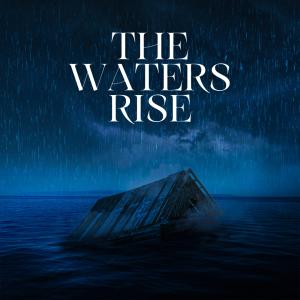
It is the end of the world as we know it. Mother Nature has had enough and is taking over. We watch one group’s fight for survival against the ever-present advancing water. How you cope in a crisis shows who you really are, not the layers, the masks, but the raw humanity.
Molly O’Neil has crafted an excellent play that moves smoothly between the main players and the chorus. The storyline immerses you into the world of these characters. Molly also played the central character narrating her experience.
The water is the star of this show. The actors worked as a smooth ensemble, threatening through sound and movement, but never looking aggressive, just smoothly and calmly advancing, intimidating and calling.
Mia was played by Temiloluwa Shobo with beautiful self-restraint and composure. Will Clay and Oli Lukasik as Seb and Miles created characters whose different approaches to the crisis and their own insecurities were played with conviction and purpose throughout. Bethan Pollard convincingly played a Isla who was out for herself. Imogen Vernon as Serena was a gentle character who the water called for. Clearer physical progression leading to her character’s demise would have created more sympathy towards her. Daisy O’Neill was believable as the young Harri she showed passion and energy throughout.
There are some creative touches with the lights for the water and stars. The sound of the water was outstanding, it was chilling and atmospheric, just make sure the actors project more when this is happening. The transitions between scenes are slick and maintain the pace of the play.
The song at the end, although excellent, slowed down the pace and tone the play had created so effectively throughout. It would have been dramatically interesting to see the two Harris sharing the narration moving between the two as the chorus vocalised underneath. Watch audience sightlines in this part.
Overall, a really well written piece of original theatre using excellent dramatic concepts, brought to life effectively by the large cast. A credit to one and all.
Jayne Fanthorpe Walker
WHAT ARE WE GOING TO DO WHEN THIS IS ALL OVER? - Split Infinitive Theatre
Split Infinitive Theatre won the John Beecher award three years ago with A Caravan Named Desire. This is their first production since then, a fact that becomes significant as you watch this new production. This time Helen and Alexander are having a party. It’s not clear why, but we’re handed invitations as we enter.
Alexander seems to want us to understand something, so he and Helen act out a series of scenes from their lives. They’re a loving couple, and Alexander is doing his best to cope with Helen’s memory loss. But what is the bigger picture? Who is really hiding something? The content gets darker, and it becomes apparent that something is very wrong. This is an immersive performance - there is no fourth wall - and this makes the play even more unsettling.
Helen and Alexander Millington are skilled actors known for producing challenging pieces. This performance left the audience with questions, which is what it’s designed to do. There is probably nothing else like this on at the Fringe - go and see it. Trigger warnings are available on Split Infinitive’s own website.
Two more performances: 17 July, 8.30pm-9.30pm and 18 July, 4pm-5pm (Underground at Spring Gardens)
Georgina Blair
YOU OUGHTA BE IN PICTURES - Polis Loizou

Theatre loves theatre shows about itself or, if that fails, about film. This is one of those, about the 'casting' adventure of just one actor as he engages with, is tested by, and works in front of, a legendary 1940's horror film director in the attempt to take over the part of the lead who has died, let's just say, mysteriously.
The mystery continues, the doubts develop - are developed - by the director as he persuades the actor to show more of himself than he expected.
This is a lovely show of so many dimensions: it's human, it's realistic, it's rooted in the movie world we are/were so fond of. But tense undercurrents gather pace, ominously and relentlessly yet always with measured good humour. To say more about the story-line would be unfair to writer/performer Polis Loizou.
His performance is exemplary, whether control of the stage as he tells us about the piece of theatre we are about to see then migrates into the role of film director, his use of the stage, with the most detailed of even small facial gestures, a winning and a most alarming way of not-quite engaging with members of the audience, not to mention appropriate voice and tight American accent. Utterly believable and friendly until you know he isn't.
The script he has developed is wonderfully rooted in the Hollywood era we know about but adds layers of exploitation, desire, selfishness, horror, and more besides. I came up with "threateningly allusive" as words that fit. Where does truth lie in the making of a movie, and what does it matter? - we were left at the end of the play with "Reality is up for grabs - remember to capture the soul" as advice for a director.
Fascinating piece with very tight writing, and beautifully performed for us with great detail: as we watch we see and feel the layers of an onion being peeled off. It's NOT a horror piece, but our delight is in watching the undercurrents as the director character manoeuvres towards what he wants.
Further performances Mon 13th and Mon 20th.
Michael Quine


